How the Body Remembers
Exploring how repetition and sensory feedback shape embodied memory through the everyday practice of making coffee.
Many everyday skills happen without conscious thought. We often struggle to explain how we perform actions that have become second nature.
This project explored embodied remembering, how repeated physical actions become stored in the body through movement, sensory feedback and experience.
Working from an initial interview study, I designed a two-week cultural probe to investigate how a professional barista's body learns, remembers and refines the craft of making coffee over time.
- Subject
Human-Centred Design Research Methods
- Duration
8 Weeks
- Team
Group research (5 researchers, 15 interviews), Individual probe study
- Methods
Semi-Structured Interviews
Affinity Mapping
Thematic Analysis
Cultural Probes
The Challenge
How do you study knowledge that people can't easily explain?
Making coffee appears simple, yet experienced baristas constantly rely on tiny adjustments in pressure, sound, temperature and movement without consciously thinking about them.
Traditional interviews capture what people can articulate.
I wanted to understand the knowledge that exists beyond words.
Phase 1
Understanding Embodied Memory
Our team began by interviewing 15 coffee makers, including professional baristas and experienced home brewers.
I personally conducted three semi-structured interviews, exploring how participants learned coffee making, the role of repetition, sensory feedback and physical memory in developing expertise. Together we synthesised all interviews using affinity mapping to identify recurring behavioural patterns.
Background
 Background
Everyday bodily movements can become automatic through repetition, sensory feedback and muscle memory - a concept described in the Embodied Remembering Experiences framework as ‘Practice makes better’.
Research in embodied cognition shows that remembering is not only a mental process but deeply rooted in the body. Coffee making, with its repetitive actions and rich sensory cues, offers an ideal case to understand how skills are learned, refined and embodied over time.
Research Questions
 Research Questions
Primary
How do the physical sensations and repetitive movements involved in coffee making become embodied memory, allowing expert users to perform the task automatically?
Secondary
To what extend does a user's personal style and the physical environment (e.g., equipments, workstation layout) influence the development and consistency of this embodied memory?
Methodology
 Methodology
Findings
 Findings
Sensory feedback is key to learning
Participants rely on sensory feedback to guide their actions. These physical cues become their primary indicator of success.
“The tamp has a certain resistance, the grinder has a hum that changes when it's working too hard,… those are cues my body relies on to repeat the process consistently.”

Repetition creates automaticity
By repeating the process over and over, participants turn a series of conscious steps into an automatic routine. This frees up their minds to do other things.
“It was a very conscious, step-by-step process. But now, it's just my hands doing it. It's like my hands have their own little brain just for coffee.”

The body stores the 'aha' moments
Breakthroughs were not cognitive but physical. These experiences are stored as physical memories, giving them a benchmark for what feels right.
“That combination of hearing the right sound and feeling the right temperature made it click for me… My body finally understood what my mind was trying to tell it.”

Challenges in mastering coffee making
Baristas face challenges in steaming milk and latte art, managing speed and precision under pressure, and maintaining consistency across staff.
“There are lots of customers and you just need to be very quick, but also not make any mistakes.”

Environment and setup shape embodied skill
The surroundings influence how the body moves. Small changes in setup or conditions require the body to adjust an create a new rhythm.
“Felt clumsy like a beginner… hands didn't know where to go.”

From home to café – a shift in process
Professional baristas rely on specialised, automated machines that guide the process, creating different workflows, skills and muscle memory.
“At Starbucks, you just put the coffee bean in, select cappuccino, and the machine does the rest. At home, I have to grind the beans, measure, and adjust settings myself. It feels completely different.”
Narrowing the Focus
From the 6 findings, I selected the two that appeared most closely connected:
- Sensory feedback is key to learning.
- Repetition creates automaticity.
Together, they suggested that expertise develops through a continuous loop of sensing, repeating and adapting.
These findings became the foundation of my probe study.
Phase 2
Designing the Probe Study
Interviews revealed what participants could explain.
To understand what they actually experienced during coffee making, I designed a two-week cultural probe.
The probe introduced small reflective activities into a participant's everyday workflow without disrupting their normal routine.
Probe Kit
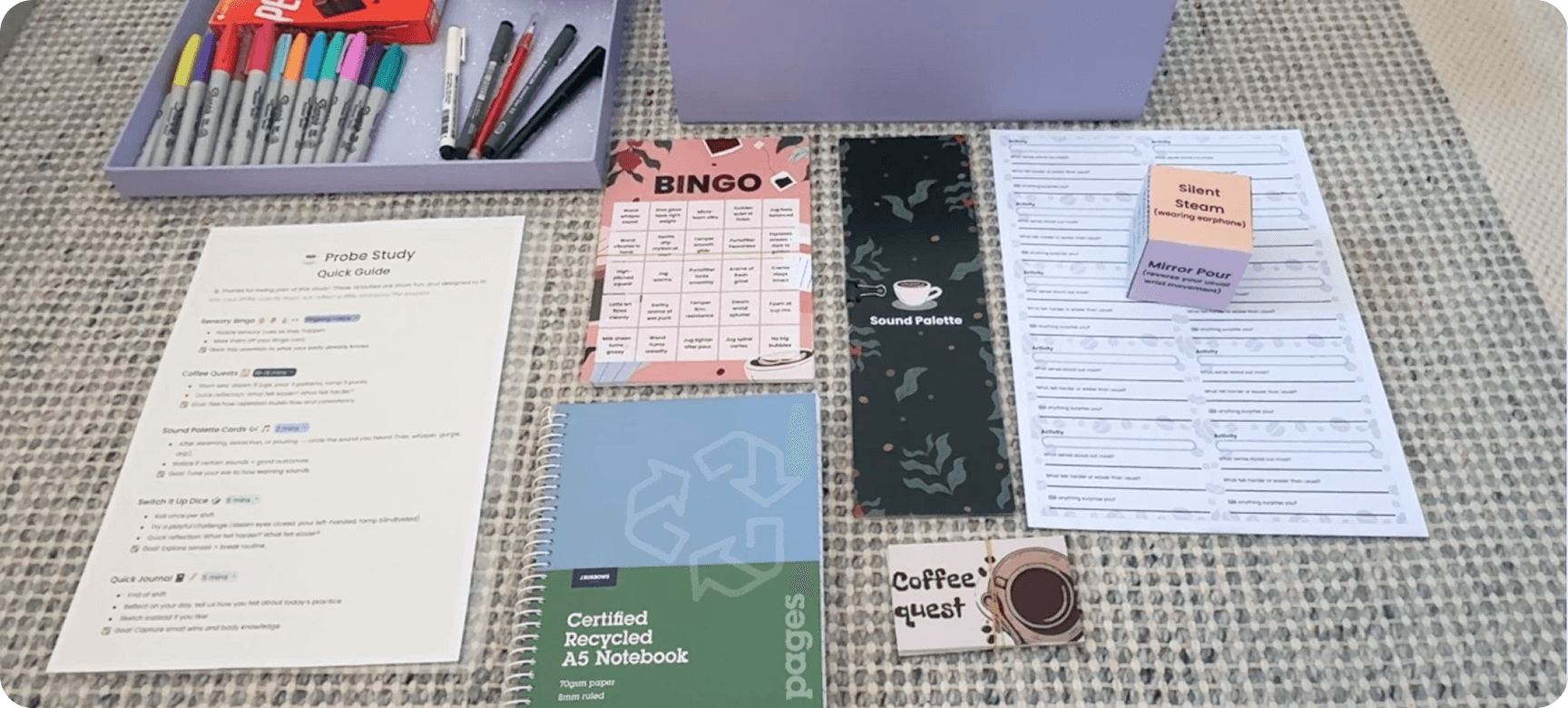
I designed five physical artefacts that encouraged reflection through doing.
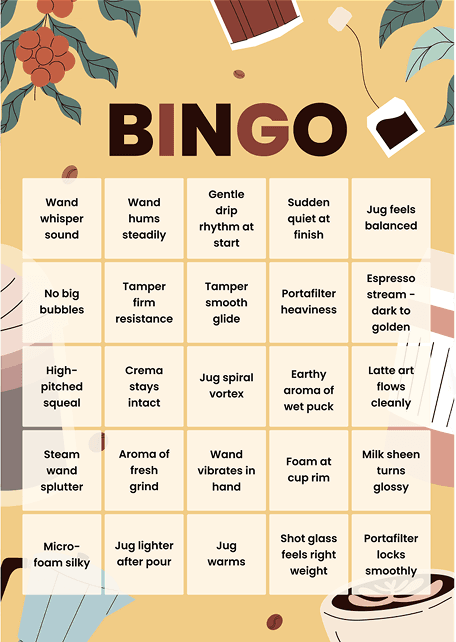
Sensory Bingo
Encouraged participants to actively notice sounds, smells, textures and visual cues throughout each shift.
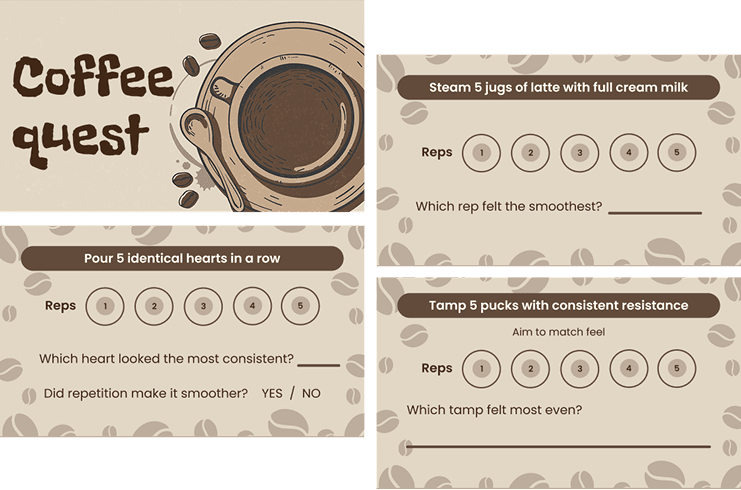
Coffee Quests
Small repetition challenges that highlighted how consistency developed across repeated attempts.
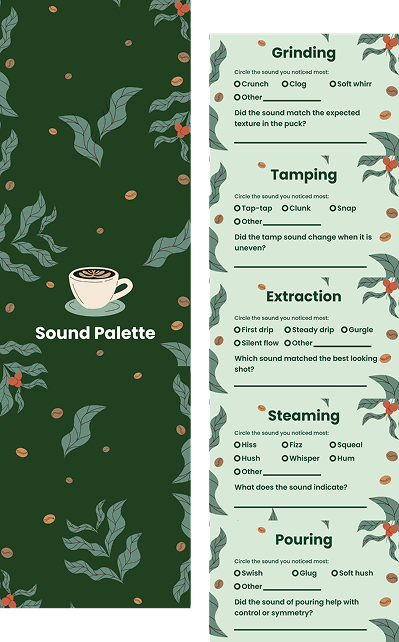
Sound Palette Cards
Helped participants describe subtle auditory feedback using descriptive language.
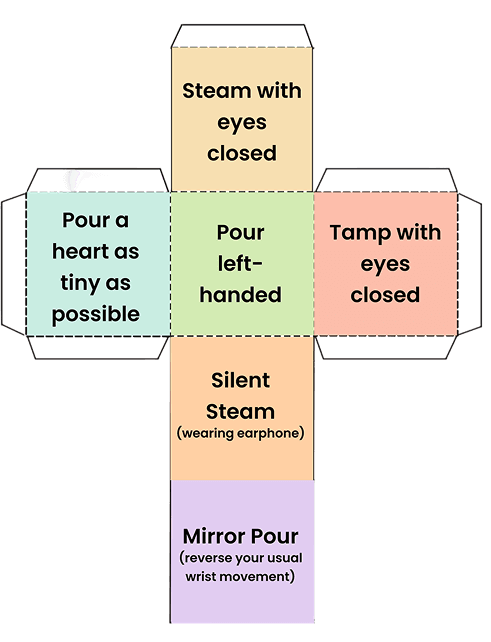
Switch-It-Up Dice
Introduced playful disruptions such as pouring with the non-dominant hand to reveal hidden habits.
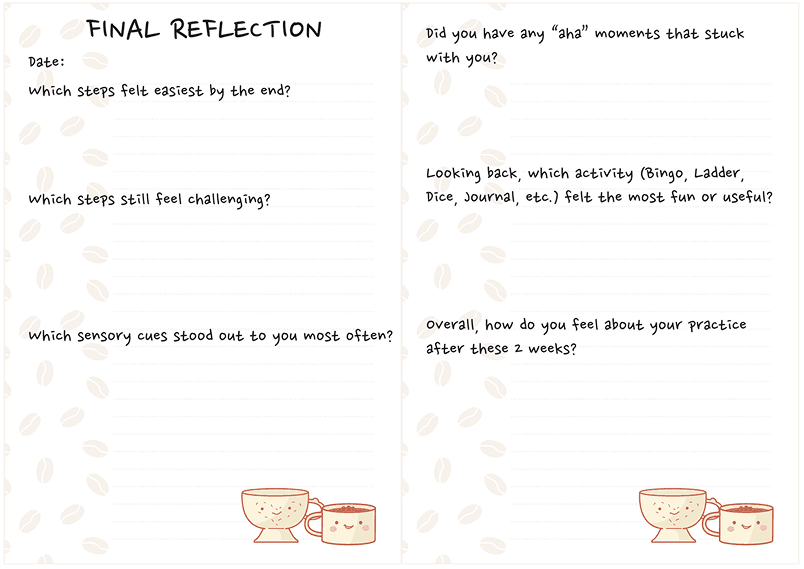
Reflection Journal
Captured daily observations and changing awareness across the two-week study.

Phase 3
Probe in the Wild
The participant was an experienced Sydney barista with approximately four years of professional experience.
Over twelve working days, she completed the probe activities during real café shifts, documenting moments of success, frustration and reflection.
Rather than observing in a laboratory, the research unfolded within the participant's everyday environment.
What Changed?
Across the study, several patterns became increasingly visible.
Routine Had Hidden Awareness
The participant realised many actions had become automatic. Simple prompts encouraged her to slow down and notice sensations she normally overlooked.
“I realised how much of my job I do on autopilot.”
Repetition Built Trust
Repeated practice created internal reference points rather than conscious instructions. Instead of remembering procedures, the participant trusted how actions felt.
“By the end, my hands just knew.”
Expertise Was Multisensory
Rather than relying on a single cue, touch, hearing and vision worked together as one coordinated feedback system.
“At the start, definitely hearing, but then touch started creeping in… By the end, I was using all of them together.”
Small Disruptions Revealed Hidden Habits
Unexpected challenges exposed deeply ingrained movement patterns and encouraged renewed curiosity.
“The muscle memory is so strong it almost resists change.”
Reflection Amplified Learning
Writing about bodily experiences transformed vague sensations into meaningful insights. Reflection became part of the learning process itself.
“Writing helped me slow down and notice patterns.”
Key Takeaway
Embodied remembering was not a linear process.
Learning evolved through a continuous cycle of noticing sensory feedback, repeating movements, reflecting on experience and gradually trusting the body's own intelligence.
Design Opportunities
The research suggested opportunities extending beyond coffee making.
- Design for sensory attention
Help learners recognise subtle sensory feedback rather than simply presenting instructions.
- Encourage playful disruption
Introduce small challenges that interrupt routine and reveal hidden habits.
- Support lightweight reflection
Capture fleeting bodily experiences before they disappear.
- Make tacit knowledge visible
Visualise patterns that are normally felt rather than seen.
Reflection
This project shaped how I think about UX research.
Interviews are excellent at uncovering beliefs, motivations and stories, but they only capture experiences people can consciously describe.
Designing a cultural probe taught me that carefully crafted artefacts can reveal an entirely different layer of behaviour, one that emerges through movement, routine and reflection. It showed me that research is not only about asking better questions, but also about creating experiences that help participants discover things they didn't know about themselves.
More importantly, it reinforced my belief that thoughtful design can make invisible human experiences visible, providing richer insights than interviews alone.
Next Projects